
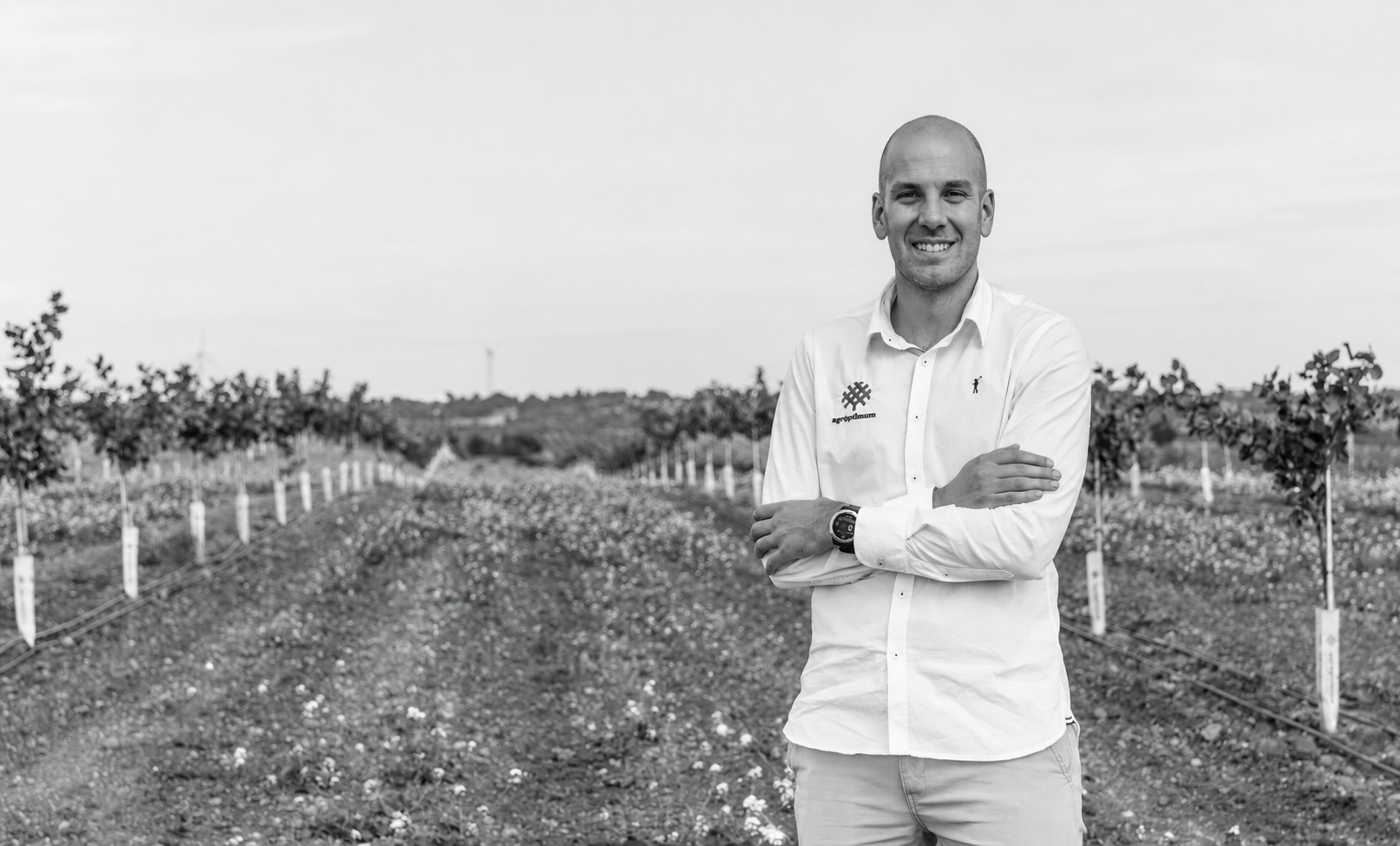
Javier Fernández. Business Development Manager at Agróptimum
Agróptimum has established itself as one of Spain’s leading companies in pistachio plant production and genetic innovation applied to the crop. How would you generally assess the evolution of this sector in Spain in recent years?
The change has been extraordinary. In just a few years, Spain has gone from being primarily a pistachio-consuming and importing country to becoming one of the leading areas for the development of this crop in Europe.
The most important thing is that we are not simply talking about an increase in the area devoted to this crop. We are witnessing the professionalisation of the entire industry: genetics, plant production, agronomic design, precision agriculture, processing, marketing and the development of new markets.
Spain currently produces around 11,000 tonnes of dried pistachios, and the forecasts we are working with point to 26,500 tonnes by 2030 and 55,000 tonnes by 2035. At the same time, domestic consumption already exceeds 28,500 tonnes per year. In other words, there is still a significant gap between what we consume and what we are able to produce here. And for me, this is precisely the opportunity: to go beyond simply producing pistachios and build a genuine pistachio industry that is competitive, fully integrated and capable of leading production in Europe, which is one of the world’s major consuming regions.
Plant quality and health are among the factors that most determine the future success of a pistachio plantation. What are the key aspects farmers should consider when selecting the planting material with which to start their project?
A pistachio plantation does not begin when the tree is planted, but much earlier: with the choice of planting material and the design of the project.
When farmers purchase pistachio plants, they should demand quality, uniformity, plant health and genetic control. Not all plants are the same, and the decision made at the nursery will influence many years of production.
I say this because at Agróptimum we have built our nursery model around this principle. Today, we have the world’s largest grafted pistachio plant nursery. It covers more than 75,000 square metres dedicated to innovation to guarantee uniformity, plant health and quality from the very beginning.
And there is something that is equally or even more important: the plant must be part of a complete agronomic project. There is little point in having a high-quality plant if there is no sound design, professional management and data-driven decision-making afterwards.
Genetic improvement is set to play a key role in the potential of this crop. What are Agróptimum’s main lines of work to develop more productive, resilient plants adapted to new climatic conditions?
Our vision is based on a very clear idea: the future of pistachio production begins with the tree.
That is why we work in genetics and plant production, while understanding that crop improvement cannot be addressed in isolation. We need to combine genetics, agronomic knowledge and technology.
Our main line of work is ongoing research into the crosses carried out as part of our plant breeding programme, which has been under development for three years. The aim is to provide pistachio growers with solutions in the future that will enable them to address the challenges posed both by mechanised management systems and by climate change. To this end, the breeding study is being carried out in two locations: one in central Spain and another further south, allowing us to anticipate changing climatic conditions.
The challenge is not simply to obtain a more productive plant. It is to achieve a more efficient and resilient production system that can make better use of every resource, particularly water.
As the sector matures, growers are increasingly demanding professional and technical advice. What are the most common unforeseen problems you are identifying in new pistachio plantations, and how can they be avoided?
Our main lesson over these 10 years is that pistachio production does not allow room for improvisation.
It is essential to plan the project properly and prepare the land adequately. Pistachio is a long-term crop, so it is crucial to prepare the soil through deep tillage that encourages root system development, allowing the roots to explore the different soil layers and optimise water resources.
Likewise, it is essential to have high-quality technical advice, adopt new technologies and know how to interpret the data obtained through the different measurement systems that we are currently incorporating, whether they are based on AI, sensors or other tools. This enables us to optimise resources and achieve competitive crops that meet market demand and requirements.
It is also important to emphasise the value of preliminary studies to anticipate the future behaviour of plantations and gain a clearer understanding of the expected returns from each plot. Although this is an agricultural crop like any other, and is therefore influenced by natural conditions, these studies allow us to anticipate potential challenges and be prepared to address them.
From your privileged position within the pistachio value chain, and after years of work and research, what do you believe will be the main challenges facing this nut sector in Spain in the medium and long term?
The first major challenge will be to ensure that the growth we are anticipating is sustainable and profitable.
Spain is going to produce much more pistachio in the coming years, but planting more hectares is not enough. We need to be able to produce efficiently, particularly in a context of pressure on water resources, while meeting increasingly demanding standards of quality and traceability, as consumers expect.
The second challenge will be industrial. Production growth needs to be accompanied by processing capacity. At present, processing capacity remains fragmented and, according to our forecasts, greater scale will be needed to absorb the expected growth.
And the third will be ensuring that Spanish pistachios do not become a commodity. We need to compete on quality, origin, traceability, security of supply and innovation.
Spain has a huge opportunity, but to take advantage of it we need to build a complete and professionalised value chain, from genetics to the final product. We must move away from opportunism.
If you could summarise in a single idea what Spain’s pistachio sector will need to remain competitive, for example by 2035, what would it be?
Sustainable productivity. Being competitive in 2035 will mean generating more value while making better use of resources. And that requires genetics, technology, agronomic knowledge, industrial capacity and an integrated value chain.
Spanish pistachios have an extraordinary opportunity, but we cannot compete on volume alone. We have to compete on what we can do better: quality, efficiency, innovation, origin and traceability.
Where do we stand today? Are we looking at a ‘trendy’ crop, bearing in mind that trends come and go? Or are we still in the early stages of a crop that has significant room to grow in order to meet a demand that still has considerable potential?
Pistachio is here to stay. And there are several figures that explain why this crop is set to become a driver of rural development in Spain.
Global pistachio demand already exceeds one million tonnes per year, while consumption in Spain exceeds 28,500 tonnes and our current production is around 11,000 tonnes of dried pistachios. The forecasts we are working with put Spanish production at 26,500 tonnes in 2030 and 55,000 tonnes in 2035.
There is therefore considerable scope for Spanish production to increase its share and meet a larger proportion of demand.
But for me, the interesting question is what kind of industry we want to build around this growth. Spain has the opportunity to develop a complete value chain: genetics, nurseries, cultivation, technology, processing and marketing. And this has enormous structural value.
Agróptimum has been very actively involved in innovation and the development of this sector for some time. What are your expectations for the World Pistachio Congress (WPC), and what opportunities does an event of this kind offer to drive pistachio growth internationally?
For us, the WPC is an opportunity to share knowledge and showcase how far the Spanish sector has come and how far it can go.
Pistachio is already a key industry for Spanish agriculture and the Spanish economy. And precisely for that reason, we need forums where growers, researchers, technology companies, industry and other key players across the value chain can share experiences and knowledge.
Spain is building a significant position in the European pistachio sector, and we need to be able to project our capabilities internationally.
Our ambition is not simply for Spain to produce more pistachios. It is for Spain to be recognised as one of Europe’s leading benchmarks for how pistachios can be produced and processed, and how value can be created around them.
 Sentido Común Internet
 Agrifood Comunicación