
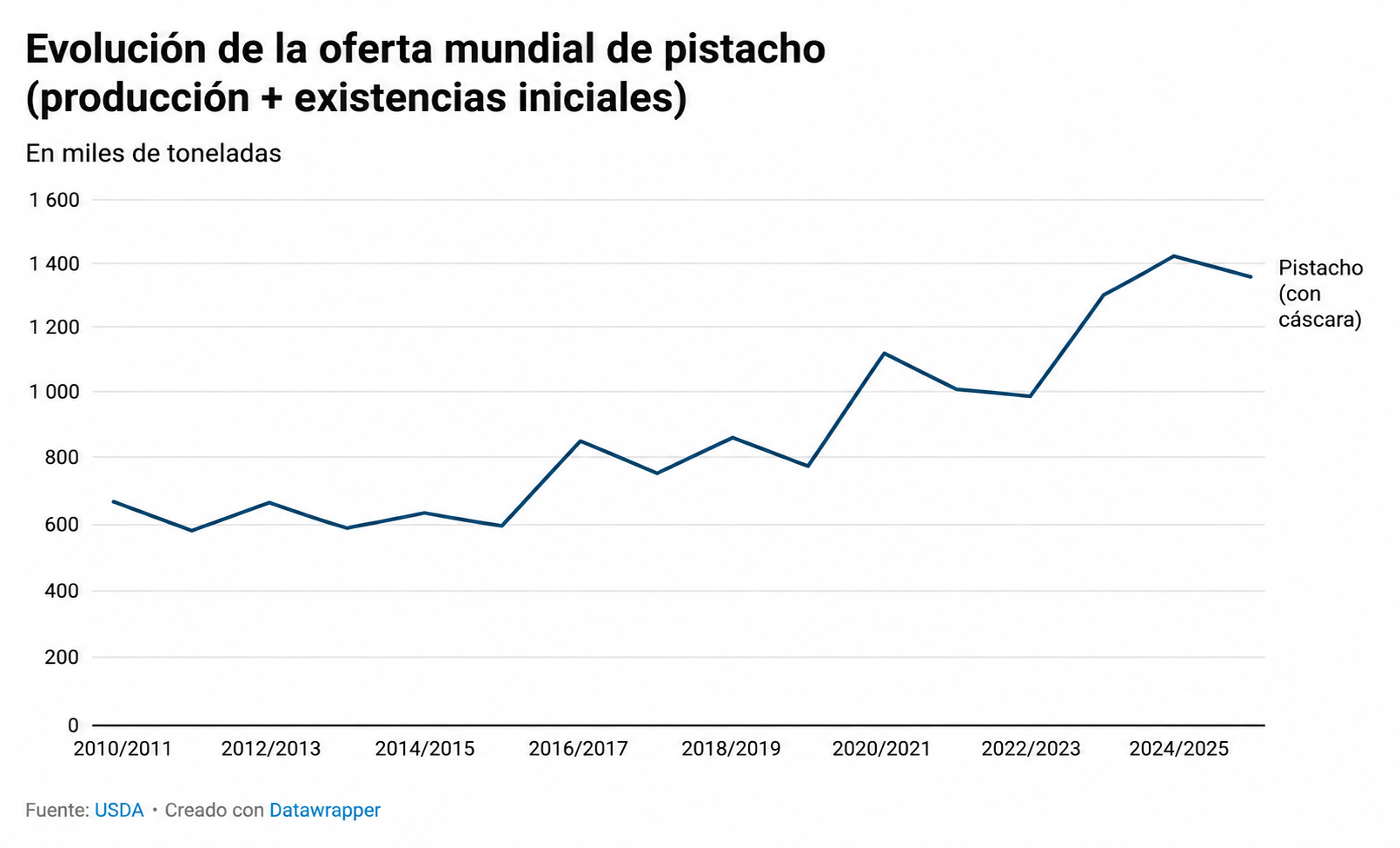
The 2025/2026 season confirms that pistachios are undergoing one of the most significant transformations seen in recent decades on a global scale. The international market is currently immersed in a process of productive rebalancing shaped by two key factors: the sharp decline in supply from Turkey and the growing leadership of the United States, which is consolidating its dominant position with a record harvest. All of this is unfolding in a context of sustained price recovery, strong international demand, and the rapid expansion of new cultivation areas, especially in Spain.
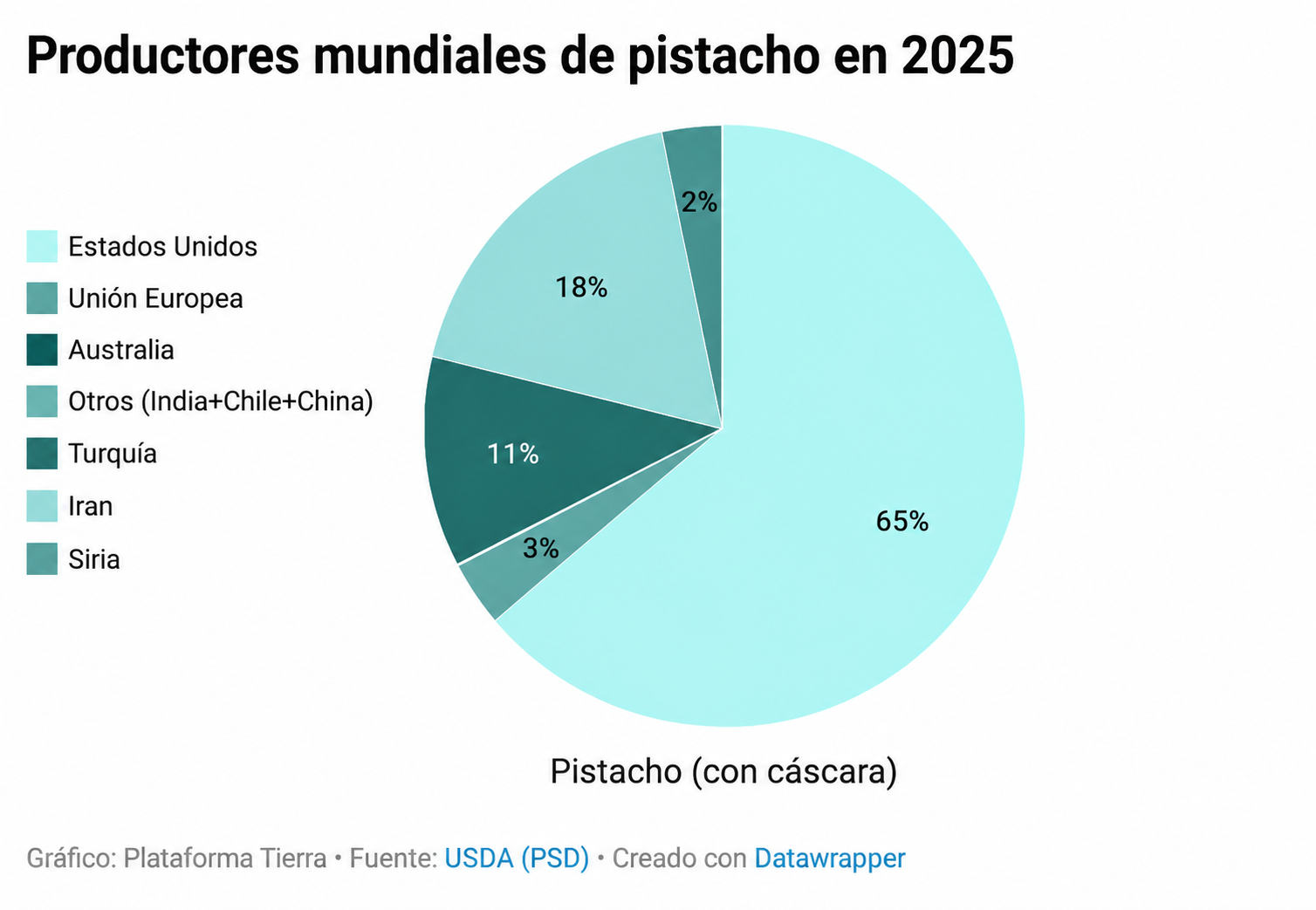
Global pistachio availability (in-shell) stands at around 1.36 million tonnes, 2.5% lower than in the previous season. Although the overall decline may appear moderate, it conceals a profound structural shift in the geographical distribution of production. Turkey, traditionally the world’s second-largest producer, has suffered a collapse of nearly 70% due to a combination of severe late frosts in April 2025 and prolonged drought conditions in the southeast of the country, particularly in the Gaziantep region. As a result, Turkey’s share of the global market falls from 33% to 11%. The United States absorbs almost the entire gap thanks to a record crop exceeding 700 thousand tonnes, increasing its share to 65% of global production.
This shift may not be temporary. The damage caused by frost to Turkish orchards could continue affecting production for several seasons, consolidating a new international balance in which California further strengthens its role as the central hub of the global pistachio market.
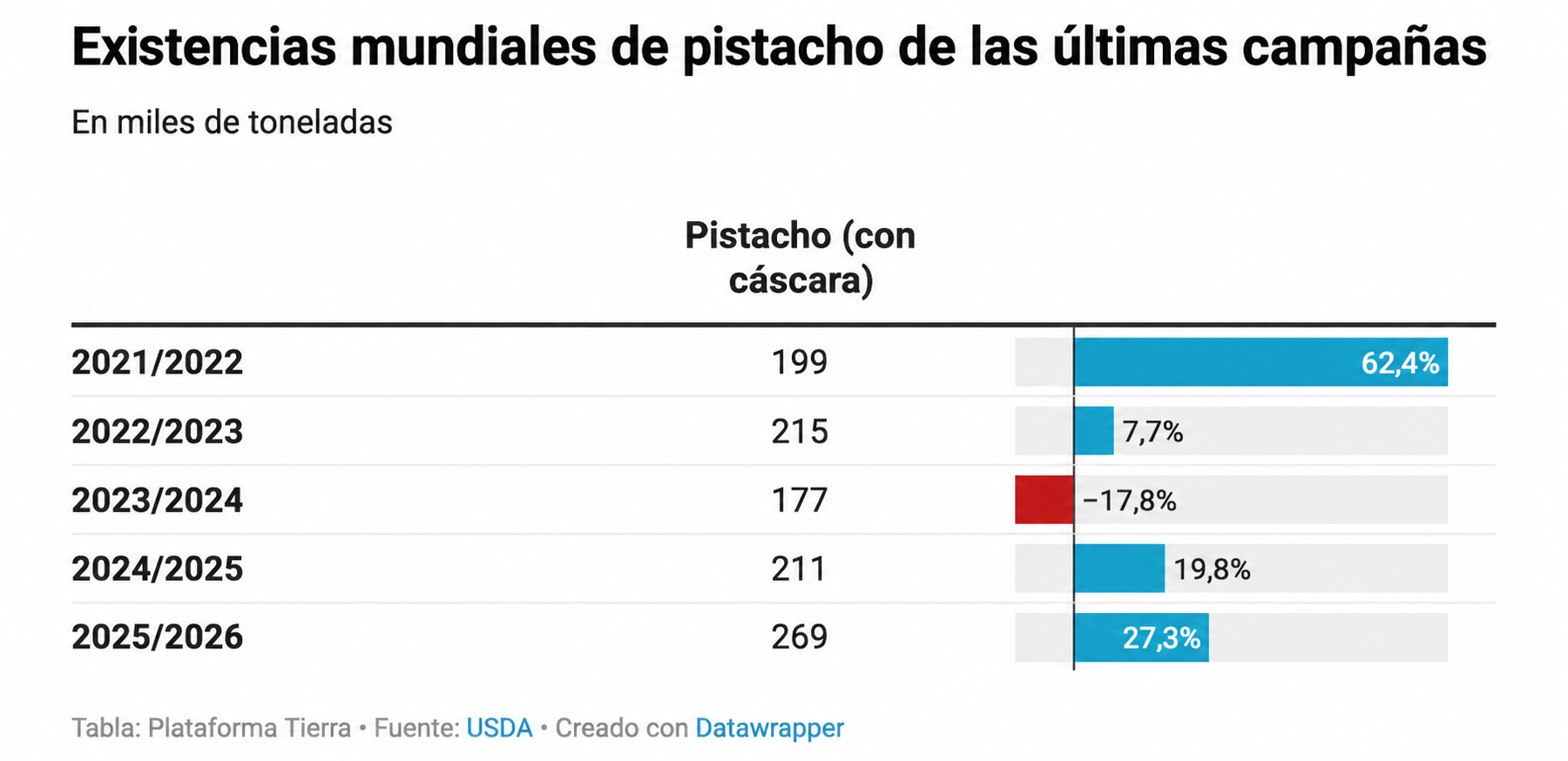
Within this international context, Spain continues to gain importance at an accelerated pace. National production reaches approximately 34,200 tonnes in 2025, up 41% from the previous year, consolidating the country as the world’s fourth-largest producer and the leading producer within the European Union, accounting for around 86% of total EU production. Even more significant is its future growth potential: only 24% of Spain’s pistachio acreage is currently in production, while nearly 67 thousand hectares remain in their juvenile or first productive stages.
Expansion continues to be concentrated mainly in Castilla-La Mancha, which already accounts for more than 77% of the national acreage. The crop is also experiencing substantial growth under irrigated farming systems, reflecting the sector’s gradual technical and business intensification.
Meanwhile, Iran maintains a significant position with around 200 thousand tonnes, although it remains constrained by international sanctions, logistical limitations, and increasing geopolitical instability in the Middle East. Tensions in the Strait of Hormuz and energy-related difficulties have added further pressure to Iranian trade, particularly in the shelled pistachio or kernel segment, which is essential for the food industry. This situation has tightened an already strained market driven by strong growth in industrial demand for pistachio-based creams, fillings, chocolates, and confectionery products.
On the demand side, the market continues to show particularly strong signals. Although aggregate global consumption declines slightly to 1.06 million tonnes (-4.4%), this adjustment reflects lower global availability rather than any structural weakness in consumption. For the first time, the European Union becomes the world’s leading pistachio consumer, surpassing both the United States and Turkey, with year-on-year growth of nearly 36%. Pistachios are thus consolidating their position as one of the most dynamic ingredients within the European food industry, driven both by direct consumption and by their expansion into categories such as chocolates, ice cream, coffee products, snacks, pastries, and spreads.
From a commercial perspective, Spain is also strengthening its strategic role as Europe’s pistachio logistics platform. Imports reach a historic record of nearly 12,800 tonnes (+17%), with the United States as the main supplier, while exports are primarily concentrated within intra-EU markets, especially Italy. The trade deficit continues widening due to the strong growth in both domestic and European demand, highlighting that national production development still does not keep pace with consumption growth.
Price performance likewise confirms the market’s structural strength. In-shell pistachios (Kerman 20/22) reach an average price in Spain of €5.43/kg, 8% higher than the previous season and the highest level in the recent historical series. Unlike other nuts, pistachios have now recorded four consecutive seasons of sustained price increases, reflecting a market with solid fundamentals on both the supply and demand sides.
Overall, the 2025/2026 season confirms that pistachios have evolved from an emerging crop into one of the most dynamic and strategic segments of the global nut industry. Spain is particularly well positioned thanks to the strong expansion of its acreage, its proximity to the European market, and the consolidation of increasingly structural demand. The main medium-term challenge will be to support this expansion with sufficient investment in processing, marketing, logistics, and efficient water management — all of which will be decisive factors in strengthening the sector’s competitiveness in the years ahead.
 Sentido Común Internet
 Agrifood Comunicación