
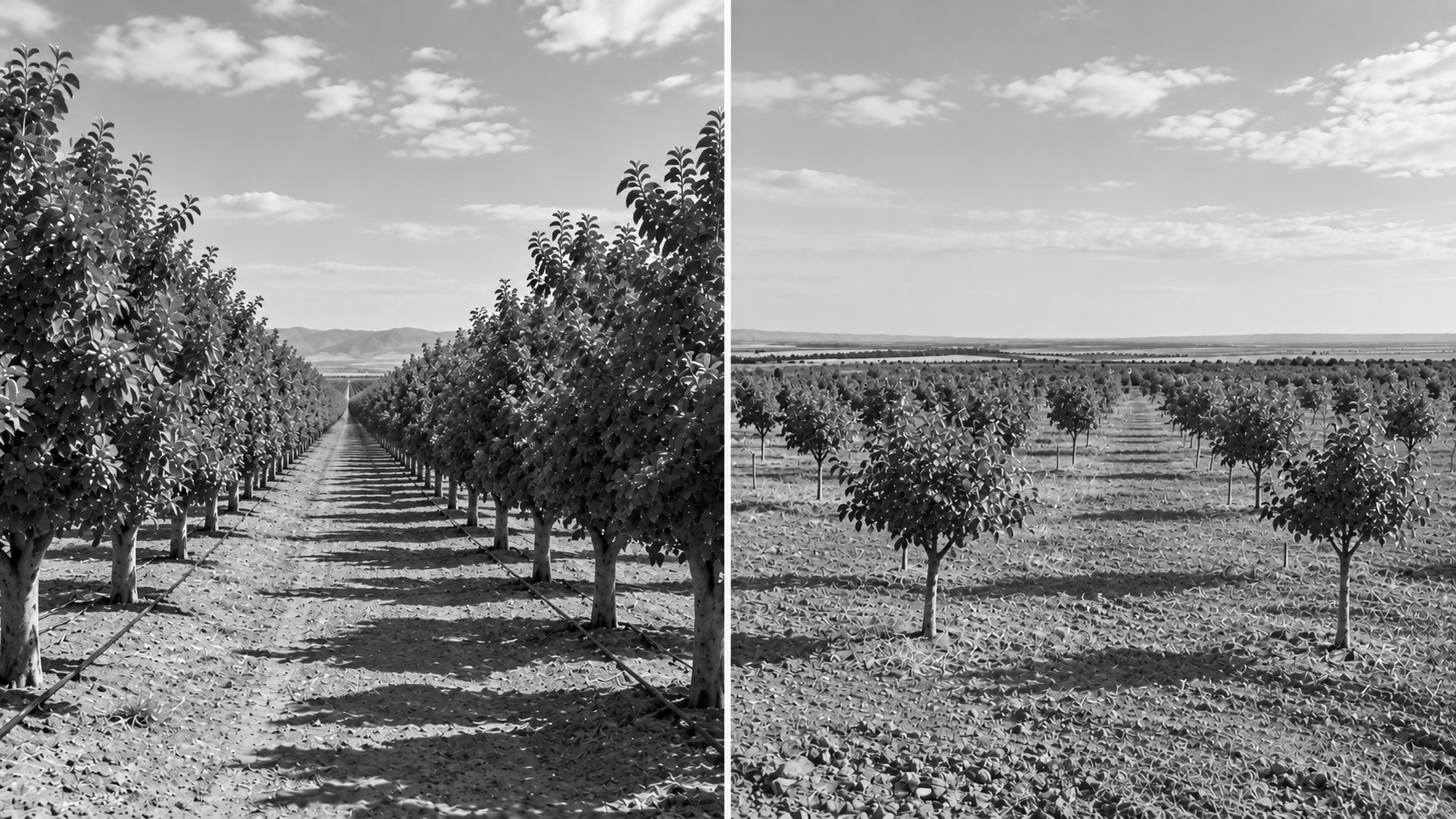
The scientific journal Environmental and Sustainability Indicators has published the article "Comparative sustainability assessment of pistachio production: A case study of California (USA) and Castilla-La Mancha (Spain)".
The authors are Gabriel Arbonès and Alberto Garrido, from CEIGRAM at the Technical University of Madrid (UPM); Lucia De Stefano, from the Faculty of Geological Sciences at the Complutense University of Madrid; Louise Ferguson and Elias Marvinney, from the University of California, Davis; and Esaú Martínez-Burgos, from the Regional Institute of Agri-Food and Forestry Research and Development of Castilla-La Mancha (IRIAF), at the El Chaparrillo centre in Ciudad Real.
The study applies the FAO's PROSA framework and analyses economic indicators (yield, price, land productivity and profitability) and environmental indicators (irrigation water, nitrogen fertilisation, soil fertility and plant protection products).
These are measured per hectare, per unit of output and through normalised indices. For Spain, the study combines statistics from the Ministry of Agriculture with a survey of 67 farms in Castilla-La Mancha covering 2,117 hectares. For California, it uses cost studies from the University of California, Davis, and data from farms in Kern County.
In 2023 the United States produced 48.8% of the world's pistachios and Spain just 1.73%, although Spanish production is growing rapidly.
Between 2011 and 2022, Spain's rainfed pistachio area grew from 3,378 to 47,235 ha and its irrigated area from 901 to 23,000 hectares. Castilla-La Mancha accounts for almost 84% of the country's rainfed area and two thirds of its irrigated area.
The results reveal two opposing strategies. California, with large mechanised farms and intensive input use, achieves a median yield of 2,610 kilos per hectare, compared with 1,415 kg/ha in Spanish irrigated orchards and 676 kg/ha in rainfed ones. It also achieves the highest profitability, at USD 10,710 per hectare, compared with USD 8,079/ha for Spanish irrigated orchards and USD 3,186/ha for rainfed ones, in constant 2022 dollars.
Its production costs, however, range from USD 5,000 to 9,400 per hectare, far above the USD 1,900 to 2,300/ha of Spanish irrigated orchards.
Spanish pistachios, on the other hand, fetch higher prices: USD 7.25 per kilo for conventional and USD 10.46/kg for organic, compared with USD 6.41/kg for Californian pistachios.
Yield vs efficiency
The authors attribute part of this yield gap to the younger age of Spanish orchards: in 2022, only a third of Spain's pistachio area had reached bearing age.
On the environmental side, the balance is reversed. California applies a median of 7,861 cubic metres of water and 179 kilos of nitrogen per hectare. Spain applies around 1,220 m³ and between 18 and 35 kg/ha of nitrogen.
Per tonne produced, Californian water use is almost four times that of Spain, and nitrogen use more than double.
Spain also stands out in organic production: in 2021, 24% of its rainfed area and 22% of its irrigated area were certified organic, compared with 1.44% of the pistachio area in California.
Overall, Spanish rainfed orchards are the most efficient system per unit of output, while Californian irrigated orchards are the most productive and profitable.
Both models face climate vulnerabilities. In California, the problem is the loss of winter chill hours, which trees need to break dormancy, together with the overexploitation of aquifers, which state legislation requires to be corrected by 2040.
In Castilla-La Mancha, growing water scarcity threatens the future viability of rainfed orchards. This pressure is driving a shift to irrigation over already stressed aquifers, where the Guadiana, Júcar and Tagus river basin authorities limit abstractions to between 1,200 and 1,800 cubic metres per hectare.
As adaptation pathways, the study points to salinity- and heat-tolerant rootstocks, low-chill cultivars, regulated deficit irrigation, precision fertilisation and agroecological practices.
It also highlights organic production, which in Spain has established a market niche that strengthens the sector's competitiveness.
The authors warn that the data for the two regions differ in time period, representativeness and scope, so the comparison should be interpreted with caution. The analysis also excludes social indicators.
As a next step, they propose coordinated trials in Spain and California under comparable conditions.
The research was funded by the Botín Foundation, through its Water Observatory, and by the Technical University of Madrid (UPM).
The article is open access and can be read in full via the link at the end of this news item.
 Sentido Común Internet
 Agrifood Comunicación